

When ChatGPT debuted nearly four years ago, the worry was that students would use it to cheat. That concern now looks far too narrow.
This academic year, AI is everywhere—and teens themselves say it’s taking over some of their thinking.
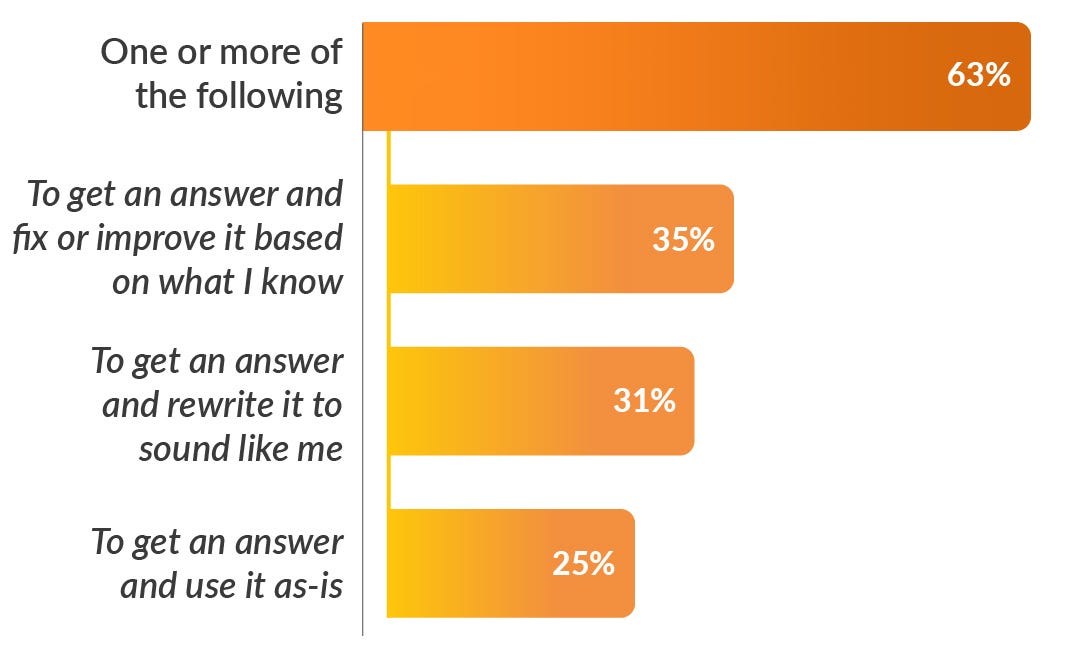
In a new nationally representative survey by Common Sense Media’s Youth AI Safety Institute, 70% of American teens age 13 to 17 said they’re using AI for schoolwork. Among those teens, 63% said they’re sometimes using AI to get answers rather than work their own way to them.
AI has become an everyday part of education before students, teachers, or parents have agreed on what it should and shouldn’t do.
“What’s really scary is that AI is working against the core craft of teaching: embracing critical thinking, developing curiosity, and making space to have dialogue,” says my colleague Yvette Renteria, chief program officer at Common Sense Media.
Renteria, a longtime teacher and principal, has more empathy for kids using AI than I expected. “You can imagine a young person seeing mom use AI, seeing teachers use it, seeing leaders use it, and thinking, ‘Oh, that’s justifiable, it’s fine, it’s safe. Everybody else is using it,’” she says.
What’s missing, she says, is AI literacy—and that has very little to do with tech skills and everything to do with human ones.
For teens, AI is complicated
It’s easy to assume that there are two kinds of teens: the ones outsourcing their thinking and the ones using AI responsibly. That’s not what we found in our survey.
Among teens who use AI for schoolwork, 63% said they get an answer from AI. But 77% of that same group said they also use AI for school help without getting an answer. Many teens reported both. The same kid who gets feedback on their writing one day might take the chatbot’s paragraph on another.
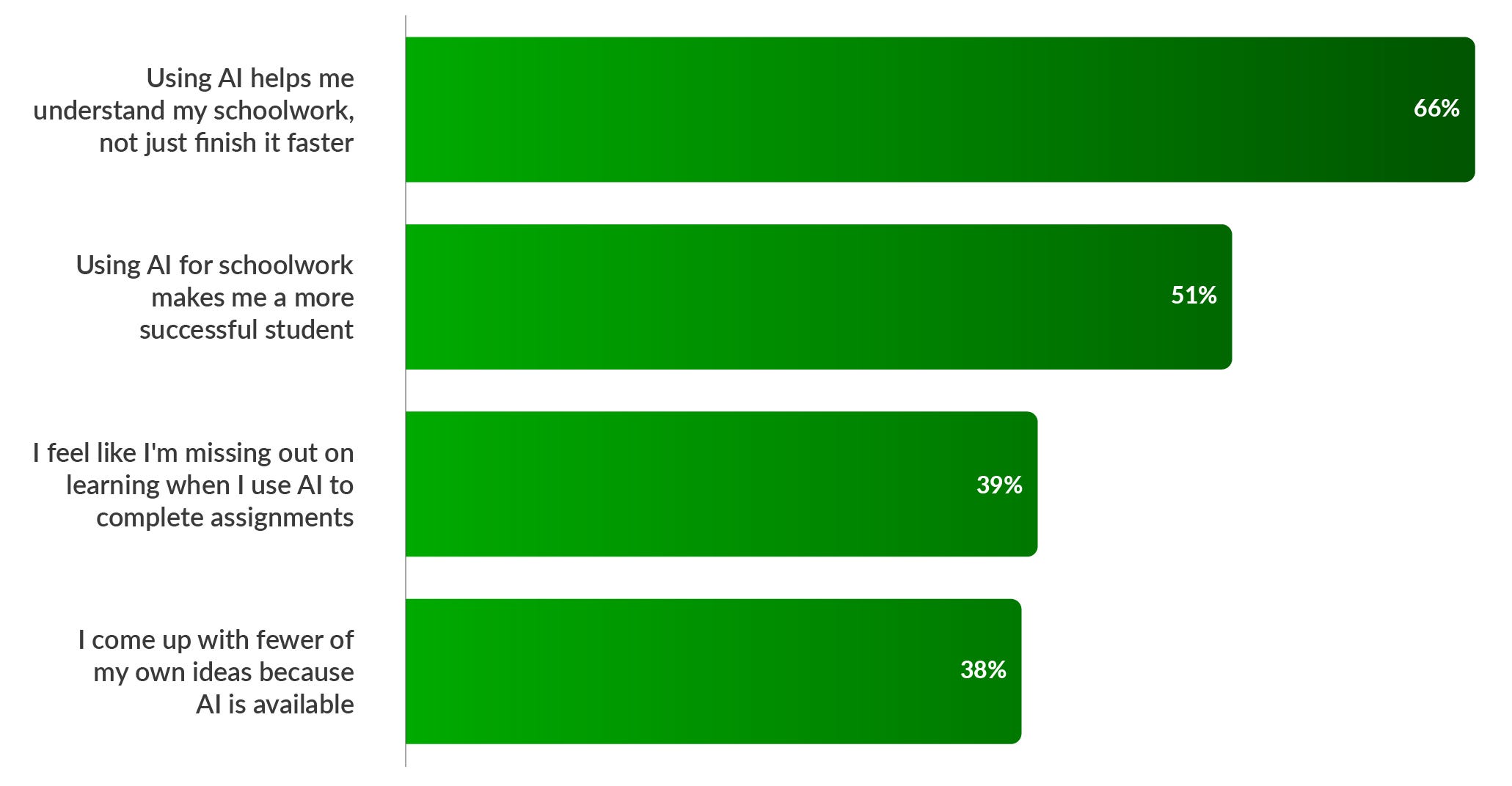
Many aren’t naive about it. Among those who use AI, 38% said having it available leads them to generate fewer of their own ideas. About the same number reported feeling like they’re missing out on learning when they use AI to finish assignments. It’s a complicated view: AI helps me, and I’m losing something.
Renteria’s worry is that even the uses that seem harmless can carry a cost. When she used to assign essays to her students, she says, there was a lot more going on than the final five-page paper. “You’re building the capacity to understand different perspectives, to make an argument. It’s so much more than even just critical thinking. It’s human connection, it’s curiosity, it’s conquering emotions,” she says.
Among teens who use AI for schoolwork, 45% said they use it to generate initial ideas or figure out how to start. But even figuring out how to start on your own is part of the learning. It forces you to generate possibilities before you know which one is right.
Something else can get lost when idea generation or brainstorming starts with AI: the social aspect of learning. A chatbot can simulate disagreement, but it can’t reproduce the human work of disagreeing with another person. “There are no people when you’re just talking to AI,” Renteria says.
What she keeps coming back to is what she calls the gray area—the part of learning where the answer isn’t settled and a kid has to stay in the discomfort long enough to think. “AI takes that away,” she says, “and quickly makes it a black-and-white answer.”
Just saying ‘don’t use AI’ isn’t enough
So far, schools have spent more energy drawing lines around AI than teaching students how to navigate it.
In our survey, nearly half of the teens who use AI for schoolwork reported that they’ve had an AI tool blocked on a school network or device. And most of them report just switching to a personal device afterward—a cat-and-mouse game that leaves kids with even less support and adult oversight.
A ban addresses the technology, but not the reason kids are using AI. According to a 2024 Common Sense Media study, 53% of teens feel pressure to be exceptional through honors classes, grades, and jobs. In this high-stakes “grind culture,” turning to AI can feel like a way to keep up. The pressure doesn’t go away when schools ban AI; kids just have one more thing to hide.
“Policies, rules, and bans—none of it matters unless you have conversations around them as an entire community,” says Renteria.
But the reality is that adults have largely left teens on their own to figure out the safety, ethics, and educational consequences of AI. In our survey, 73% of teens said that they’ve never talked to a teacher about what AI is and how it works. Only a quarter have ever had a classroom discussion about how to evaluate whether AI-generated information is actually accurate or trustworthy.
Renteria says many teachers don’t feel equipped to offer guidance about a technology they’re still trying to understand themselves. “They say: ‘I just want to teach my seventh graders English. I know this stuff, I feel confident in it. And now you’re bringing in AI—what am I supposed to know or not know?’”
AI literacy starts with human skills
Kids heading back to school this fall are already using AI. Now it’s time for adults to help them use it wisely.
Renteria says teachers need to start talking about AI, regardless of the subject matter they teach. And rather than feeling pressured to be AI experts, teachers can openly discuss their own learning curve to build trust and community. She suggests co-learning with students by running simple classroom experiments, like saying: “We’re going to do this together, class. Let me show you. What happens if we all put the same question into AI? Do we all get the same answer back? How do we figure out which is correct?”
Those conversations should happen at home, too, where many parents also feel behind. Start by asking why your kid is using AI. Is a class moving too quickly for them to keep up? Does asking for help make them feel like a burden? The answer often points to something other than laziness. (For more advice on school success in the AI era, check out this video and activity guide.)
To help bring AI literacy into the classroom, Renteria led the development of a new Digital Literacy & Well-Being Curriculum focused on AI. One course examines how chatbots are specifically engineered to make you feel like “they” get you—and what that might mean for how kids trust and use these tools over time.
There’s one finding in our survey that suggests teens may be further along than the adults arguing about how AI will impact them.
We asked teens to pick the three skills they think will matter most for their future as adults. The most common choice was working well with other people—55% put it in their top three.
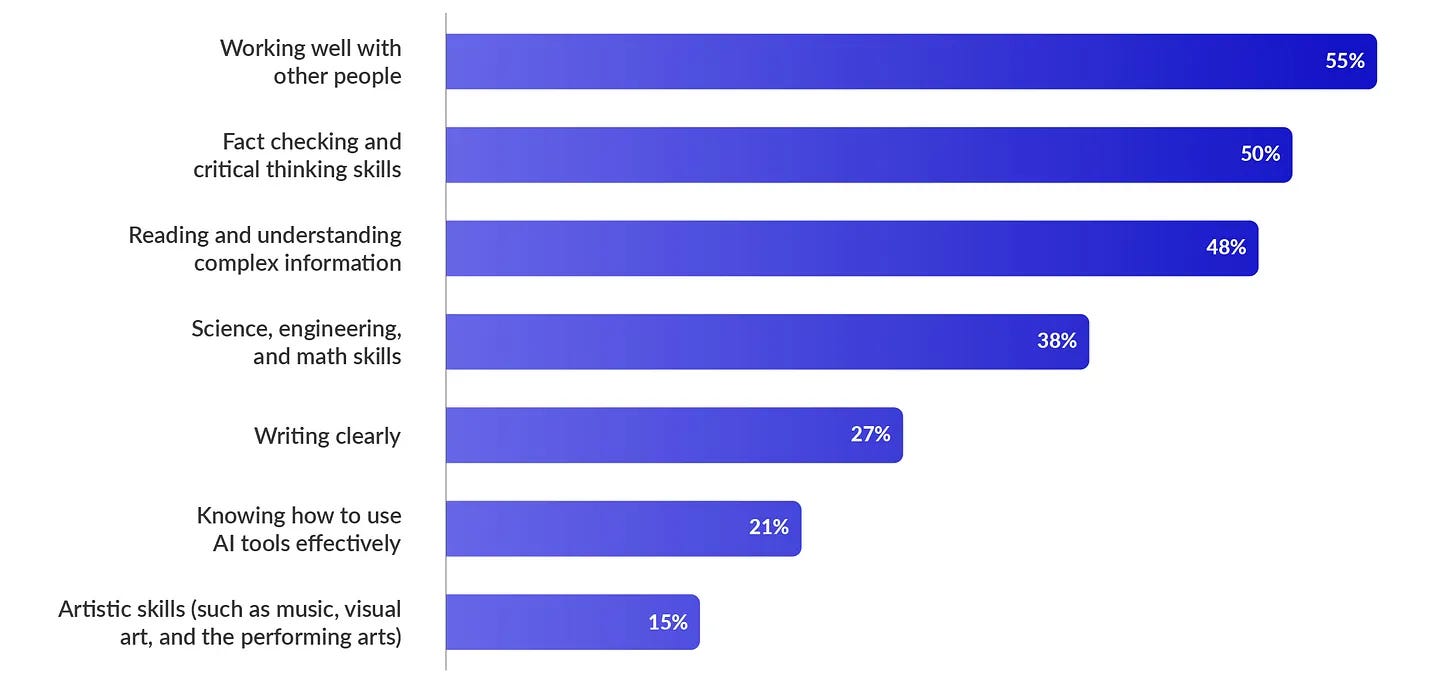
Knowing how to use AI tools effectively came in near the bottom of the list, selected by just 21% of teens.
Preparing kids for the AI era shouldn’t primarily mean teaching them to become better at using AI. It should mean strengthening the human abilities that AI can too easily allow them to skip: wrestling with uncertainty, developing an idea, disagreeing with someone and finding a way forward.
I asked Renteria what she thought was the most important skill to develop for the AI era. “Human connection,” she said.
Perhaps the most important thing we can teach kids about AI is what it can never replace.
Reading this made me think that perhaps what could help address this problem is an AI interface designed for student learning. Perhaps such a thing exists already. A school could say "use of AI is allowed but it has to be this AI," and it would be a chat bot designed by educators, that responded to questions not with spoon-fed answers, but with questions back in response -- a conversation, if you will -- offering help, but not before asking the kinds of questions a teacher would ask in office hours. What do you think the answer is? How should I go about finding out if that's right? Where would you like me to look? How would you suggest structuring the answer? Or in writing, which of these is your core argument? etc.
Exactly it is ruining creative thinking and the ability to stretch our own minds